Friday, September 23, 2016

Distance and Time and Special Relativity - Freaky Fzx Friday

The experiment from our last installment of Freaky Fzx Friday was high precision.  Extremely high precision.  So good that we knew without a doubt that all observers in the universe measure light speed to be the same no matter what the source or observer are doing.

Imagine that my aging arm can put out some HEAT


and you're waiting for a PAT bus at the corner of Fifth.  I'm in a bus traveling past you at 50 mph and I throw my amazing fastball toward the front of the bus.  What speed do you measure for the ball?


It has to be greater than 50 mph since the bus is already moving so you just add the speeds and get 150 mph forward.

Now I'm at the front of the bus, distracting the driver, and I see a misbehaving student in the back seat.  I take my fastball and send it in her direction.  What speed does she measure?  100 mph.  What speed do you measure as you record the whole thing with your iPhone to forward to the authorities and the media?


50 mph backward.

It turns out that the same principle works with sound waves in my enclosed bus.  You would just add or subtract the velocities, depending on the situation.

Later, in another bus, with different bus driver and a laser gun, we perform the same experiment and you're still waiting for the bus.

Proper Gangsta Grip for Accuracy

I always measure that light to travel at 186,000 mph.

The new bus is moving 100,000 mph.  What speed do I measure for the light beam?  186,000 mph.  What speed do you measure as I pass on the corner at 100,000 mph?


Nope. You measure 186,000 mph.  It is NOT the sum of the speeds this time.

Now let's do it again but in a different direction.  I still measure 186,000 mph.  What speed do you measure?  (And how many style points do I get?)


Crap.  Still 186,000 mph!  What's going on?  

Light does not act like the baseball and we cannot just add or subtract velocities.  Lorentz had already proposed his transformations.  It was Einstein who put it all together and explained it after almost two decades of the best minds working on the problem.

1) while moving at different speeds we measure distance and time differently.  But everybody measures everybody else's distance and time to be different.

2) and everybody's correct.  There is no absolute time or space.  Time and distance ARE different depending on your relative speed.

Freaky.  Next time, Simultaneity and Twins.

Friday, September 9, 2016

Speed of Light - Freaky Fzx Friday Introduction

A normal Fzx course rarely deals with the wonderful aspects of science discovered after the American Civil War.


I instituted Freaky Fzx Friday two years ago to give a bit of modern physics on a regular basis.

Todays topic - the speed of light.  Light is fast and difficult to measure.  After Galileo observed the moons of Jupiter, Roemer measured the speed of light using the orbit of Io in 1676.


Light travels at 186,000 miles every SECOND.  Ridiculous and far faster than Earth at at 65,000 miles per HOUR around the sun.

But by 1887, Michelson and Morley had precise instruments capable of measuring tiny differences in the speed of light.  They tried to detect the stationary background of space by comparing the speed of light parallel to and perpendicular to the motion of Earth around our Sun.


There was ZERO DIFFERENCE between the two speeds.  They checked their instruments and repeated the experiment to no avail.  It seemed that light has the same speed no matter its direction or the speed of the source..

Next time - Einstein's interpretation of the results.

Tuesday, May 3, 2016

Tek Tip 2sD - Electric vs Hybrid vs Gasoline vs Diesel

Electric vehicles like the Baker Electric from 1905 and the Zero FXS use only a batteries and electric motors.

Friday, April 29, 2016

Freaky Fzx Friday - Large Hadron Collider

Large - 17 mile long loop and the biggest machine ever.
Hadron - Any particle made of quarks, antiquarks, and gluons.
Collider - A particle accelerator designed for collisions.

If you want to read about it, here's a great link:
     CERN's Large Hadron Collider

These videos'll help you understand a tiny bit.

Wednesday, April 27, 2016

Tek Tip 2sD - Know your Device and Hack it

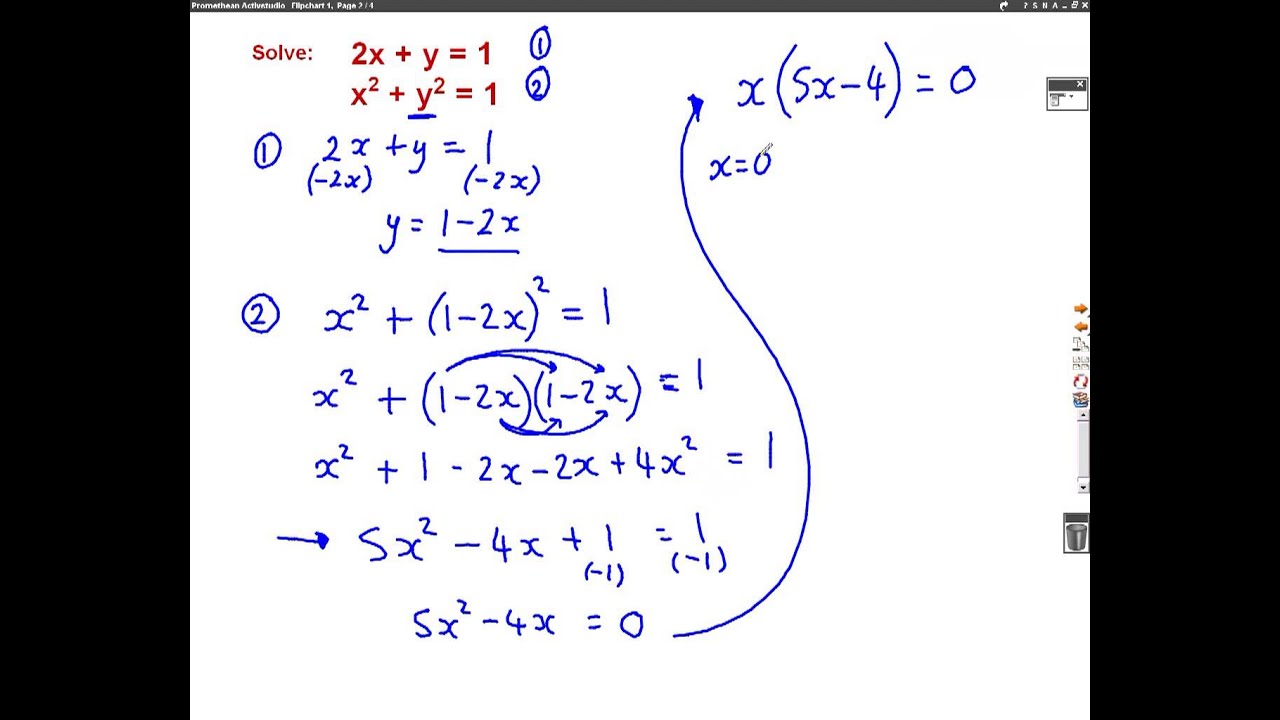
Solving simultaneous equations:


We can substitute and solve, stack and solve, or use the graphing calculator and find the intersection of the two functions. My old TI-85 had a simultaneous equation solver.

Friday, April 22, 2016

Freaky Fzx Friday - Empty Space

HORROR VACUI - "Nature Abhors a Vacuum" - Aristotle, 350 BC

Aristotle seemed to believe that the speed ratio of an object falling in different materials is the same as the density ratio.  Using this logic, an object's speed while falling in a vacuum would be infinite.  Since that speed is not possible, a vacuum is not possible.

2,400 years ago, Aristotle was a proto-scientist.  He wasn't doing science as we consider it today but for various reasons his ideas stood for two millennia.  He was wrong on just about everything.

Turns out, however, that was pretty much correct on the vacuum thing.  Interesting.


Tuesday, April 19, 2016

Tek Tip 2sD - Electric Blanket Fix

Slim's Story - 

"So this [electric blanket] has been on my [impressively long] list for a while and I finally got around to fixing it.

"And I learned some things in the process.  Like there’s a term for the resistance of a capacitor in an AC circuit, called “Reactance.”  And since it is an inverse function of Capacitance and Frequency, as a capacitor loses its ability to store charges, it becomes a larger resistor.  I knew it had to be the two film capacitors, because they had mains voltages across them when I tested.

"Kids, don’t try this at home.  Never disassemble and power a device with exposed mains voltages.