Friday, October 21, 2016

General Relativity - Einstein Again - Freaky Fzx Friday

Galileo and Newton and all scientists until Einstein considered space and time to be separate and unaffected by the observer.

In 1905 Albert Einstein explained how it was possible that light would be measured the same for all observers no matter the speed of the light source.  It was a triumph of perspective - the facts were all there but took an Einstein to put it all together.


Special Relativity is a collection of facts about how things act when traveling near the speed of light.  It is "Special" because it only deals with objects traveling at a constant velocity.  Special Relativity introduces "SPACETIME"  to our vocabulary - the three dimensions of space and the dimension of time are all related to each other and measurements of spacetime can vary depending on perspective.

It's SPECIAL because it is limited to constant velocity

Now united as one, space and time affect each other

We live in 3 spacial dimensions and one time dimensionj

"At rest" = ANY constant velocity
If you  can't tell the difference by experiment, there is no difference

No longer constants - now dependent upon velocity 
but only from an external perspective
everything looks normal from inside

It took Einstein another decade to figure out how to extend his Special Theory of Relativity to objects that are doing more than just moving at a constant velocity.  This is called his General Theory of Relativity.


If there is no internal experiment that can be done to differentiate among a high constant velocity, a low constant velocity, or "rest" - those states must be equivalent.

In the same way, if there is no internal experiment that can be done to differentiate among a gravitational field and acceleration, those states must be equivalent.  But first back to Newton and his Law of Universal Gravitation.


Let's compare you in a rocket (far from earth) accelerating "up" at 9.8 m/s/s and you in a rocket-shaped room on the surface of earth in a gravitational field of 9.8 N/kg.


If you can't tell the difference between the two with an internal experiment, they must be the same.


One crazy conclusion is that acceleration of an object and the effect of a gravitational field are equivalent.  Let's do another experiment using a laser or a beam of light in an accelerating rocket.


Fire that laser under a massive acceleration and both internally and externally you would see a curved beam.  The floor is moving toward the point of origin of the beam of light.


Remember that equivalence principle - acceleration and g-field are the same so everything that would happen under a huge acceleration...


...would happen in a huge gravitational field.  But if mass attracting mass is what makes gravitational force we have another problem since light has not mass and shouldn't be affected by a gravitational field.


Here's where Einstein's twisted mind comes in again.  If gravity attracts light and bends it but light has no mass, how does it do that?


That pesky spacetime again must be affected not only by relative velocities but by large concentrations of mass and gravitational fields and accelerations.


Mass bends time.  An atomic clock in orbit around earth runs faster than the same one on earth.  Even more slowly at the surface of our sun.  And even more slowly near a black hole.


Ridiculous.  Even more ridiculous is that light is bent when near a big mass like our sun.  It was during a solar eclipse in 1919 that scientists took pictures of the stars around the sun and found a star that should not have been visible.  The light had been bent by the gravitational field near the surface of the sun - the first experimental verification of Einstein's General Theory of Relativity.

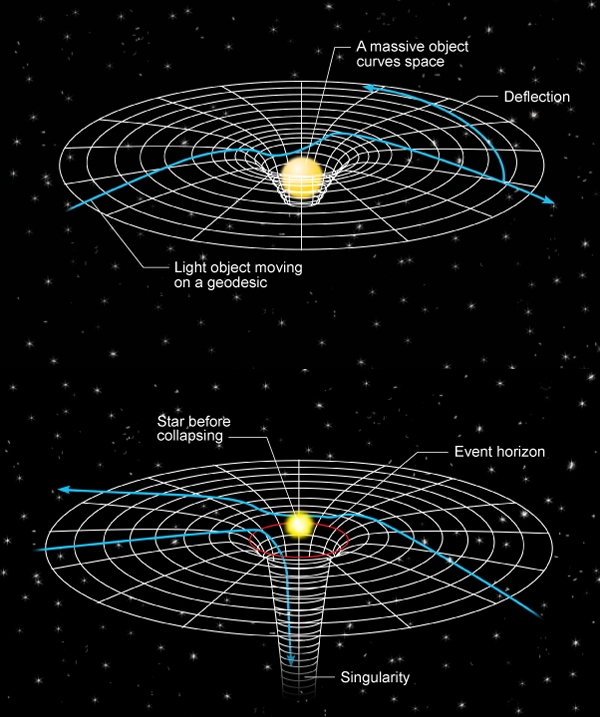

BUT - Einstein again - the  light isn't the thing that is bent.  Spacetime is bent and light follows a straight line.


And remember that gravity- acceleration equivalence principle again - the same would happen under acceleration - Acceleration bends spacetime too so that twin paradox isn't a paradox, it just depends on the bending of spacetime under acceleration (gravity field).


That "twin paradox" from last time depends on the acceleration/gravity field effects of General Relativity.

Einstein's twisted mind again.  This time with more math.


Thursday, October 20, 2016

Friction Terms

Here are the friction terms we should use with explanations below.

Types of Friction:

  • Surface Friction - a force parallel to the surfaces in contact that resists sliding
    • Sliding Surface Friction (Kinetic Surface Friction) - Surface friction for two surfaces moving - sliding - past each other.
    • Static Surface Friction - Surface friction for two surfaces at rest with respect to each other - no  sliding.
  • Rolling Friction  - A resistive force on a rolling object because of tire deformation.
  • Fluid Friction - A resistive force on an object moving through a liquid or a gas.
-----------------------------------------------

Sliding Surface Friction

Surfaces sliding past each other

Rear wheels sliding

Static Surface Friction - 

As long as the tires don't slide
a car stays in static friction in normal travel
even though it's moving.

Static - no sliding

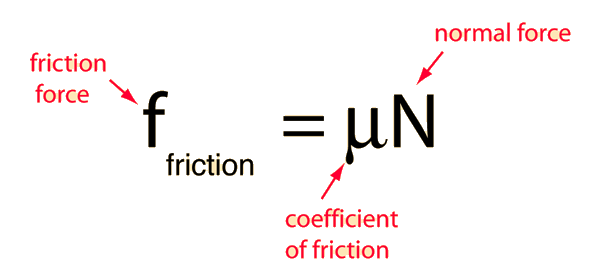
Both types of surface friction are dependent upon the NORMAL FORCE between the surfaces and the SURFACES in contact.  Here is the equation - it is a good approximation of reality for smooth and dry and solid  surfaces.


Two additional links on surface friction
          HyperPhysics on friction
          More HyperPhysics on friction

-------------------------------------------------

Rolling Friction - 


Tire base deformed leading to rolling resistance


--------------------------------------------------

Fluid Friction - 


Friday, October 7, 2016

Relative Simultaneity and Aging - Freaky Fzx Friday

Einstein's 1st postulate - his starting point - for Special Theory - is that the speed of light is measured the same no matter the speed of the source or observer.  That was based on the Michelson-Morley experiment from 1887.

Einstein's Special Theory of Relativity is so named because it only deals with the special case of objects moving at a constant speed in a straight line.


This point of view - or Frame of Reference - is called an "inertial frame of reference"


So clocks run slow and mass increases and length contracts but only from the external perspective.

Internally everything looks normal and is measured to be normal and IS normal.  That's Einstein's 2nd postulate.

Simultaneous events in one frame of reference might not be simultaneous in another.  Both are correct.


And our final piece of Special Relativity is the Twin Paradox.  It's called a paradox if you are only looking at it from the Special Relativity perspective.


Next time - General Relativity - The real reason that the traveling twin ages more slowly.

Friday, September 23, 2016

Distance and Time and Special Relativity - Freaky Fzx Friday

The experiment from our last installment of Freaky Fzx Friday was high precision.  Extremely high precision.  So good that we knew without a doubt that all observers in the universe measure light speed to be the same no matter what the source or observer are doing.

Imagine that my aging arm can put out some HEAT


and you're waiting for a PAT bus at the corner of Fifth.  I'm in a bus traveling past you at 50 mph and I throw my amazing fastball toward the front of the bus.  What speed do you measure for the ball?


It has to be greater than 50 mph since the bus is already moving so you just add the speeds and get 150 mph forward.

Now I'm at the front of the bus, distracting the driver, and I see a misbehaving student in the back seat.  I take my fastball and send it in her direction.  What speed does she measure?  100 mph.  What speed do you measure as you record the whole thing with your iPhone to forward to the authorities and the media?


50 mph backward.

It turns out that the same principle works with sound waves in my enclosed bus.  You would just add or subtract the velocities, depending on the situation.

Later, in another bus, with different bus driver and a laser gun, we perform the same experiment and you're still waiting for the bus.

Proper Gangsta Grip for Accuracy

I always measure that light to travel at 186,000 mph.

The new bus is moving 100,000 mph.  What speed do I measure for the light beam?  186,000 mph.  What speed do you measure as I pass on the corner at 100,000 mph?


Nope. You measure 186,000 mph.  It is NOT the sum of the speeds this time.

Now let's do it again but in a different direction.  I still measure 186,000 mph.  What speed do you measure?  (And how many style points do I get?)


Crap.  Still 186,000 mph!  What's going on?  

Light does not act like the baseball and we cannot just add or subtract velocities.  Lorentz had already proposed his transformations.  It was Einstein who put it all together and explained it after almost two decades of the best minds working on the problem.

1) while moving at different speeds we measure distance and time differently.  But everybody measures everybody else's distance and time to be different.

2) and everybody's correct.  There is no absolute time or space.  Time and distance ARE different depending on your relative speed.

Freaky.  Next time, Simultaneity and Twins.

Friday, September 9, 2016

Speed of Light - Freaky Fzx Friday Introduction

A normal Fzx course rarely deals with the wonderful aspects of science discovered after the American Civil War.


I instituted Freaky Fzx Friday two years ago to give a bit of modern physics on a regular basis.

Todays topic - the speed of light.  Light is fast and difficult to measure.  After Galileo observed the moons of Jupiter, Roemer measured the speed of light using the orbit of Io in 1676.


Light travels at 186,000 miles every SECOND.  Ridiculous and far faster than Earth at at 65,000 miles per HOUR around the sun.

But by 1887, Michelson and Morley had precise instruments capable of measuring tiny differences in the speed of light.  They tried to detect the stationary background of space by comparing the speed of light parallel to and perpendicular to the motion of Earth around our Sun.


There was ZERO DIFFERENCE between the two speeds.  They checked their instruments and repeated the experiment to no avail.  It seemed that light has the same speed no matter its direction or the speed of the source..

Next time - Einstein's interpretation of the results.

Tuesday, May 3, 2016

Tek Tip 2sD - Electric vs Hybrid vs Gasoline vs Diesel

Electric vehicles like the Baker Electric from 1905 and the Zero FXS use only a batteries and electric motors.

Friday, April 29, 2016

Freaky Fzx Friday - Large Hadron Collider

Large - 17 mile long loop and the biggest machine ever.
Hadron - Any particle made of quarks, antiquarks, and gluons.
Collider - A particle accelerator designed for collisions.

If you want to read about it, here's a great link:
     CERN's Large Hadron Collider

These videos'll help you understand a tiny bit.